Digital Infrared Photography & Conversion FAQ
Which digital cameras do you modify and what is the conversion price?
We convert or modify all of the following digital cameras:
("Please contact us if you don't see your camera listed as we may still convert it for you!)
|
CAMERA MODELS
|
CONVERSION PRICE
|
|
|
Nikon Digital Cameras:
|
All Conversions excluding UV
|
Ultraviolet
|
|
D40*¹, D40x, D50, D60*², D70, D70s, D80, D90*², D100, D200, D300*², D300s*², D500*², D3000*², D3100*², D3200*², D3300*², D3400*², D5000*², D5100*², D5200*², D5300*², D5500*², D5600*², D7000*², D7100*², D7200*², D7500*², 1 V1, 1 V2, 1 V3, 1 J1, 1 J2, 1 J3, 1 J4, 1 J5, 1 S1, 1 AW1, Z50. Z fc, Z30
|
$275 |
$450
|
|
D1, D1x, D2x
|
$350
|
$450
|
|
D600*², D610*², D700*ª*², D750*ª*², D780*ª*², D800*², D800E*², D810*², D850*², Z5, Z6, Z6mk2, Z7, Z7mk2, Z8
|
$350
|
$675
|
| D3*ª*², D3x*ª*², D3s*ª*², D4*ª*², D4S*ª*², D5*ª*², D6*ª*², Df*ª*², D5*ª*² |
$350
|
$675
|
|
Coolpix 950, 990, 995, 5400, 8400, P5000, P5100, P6000, P7000, P7100, P7700, P7800, S8100, P900, P950
|
$175 |
N/A
|
|
Coolpix A
|
$275 |
N/A
|
|
Canon Digital Cameras:
|
All Conversions excluding UV | Ultraviolet |
|
D30, D60, 10D, 20D, 30D, 40D*³, 50D*³, 60D*³, 70D*³, 80D*³, 90D*³, 77D*³, 7D*³, 7Dmk2*³, DRebel (300D), DRebel XT (350D), DRebel XTi (400D)*³, DRebel XSi (450D)*³, DRebel XS (1000D)*³, DRebel T1i (500D)*³, DRebel T2i (550D)*³, DRebel T3i (600D)*³, DRebel T3 (1100D)*³, DRebel T4i (650D)*³, DRebel T5i (700D)*³, DRebel T5 (1200D)*³, DRebel T6 (1300D)*³, DRebel T6s (760D)*³, DRebel T6i (750D)*³, DRebel T7 (2000D)*³, DRebel T7i (800D)*³, DRebel T8i (850D)*³, DRebel SL1 (100D)*³, DRebel SL2 (200D)*³, DRebel SL3 (300D)*³, EOS M*³, EOS M3*³, EOS M5*³ , EOS M6*³ , EOS M6mk2*³ , EOS M10*³ , EOS M50*³ , EOS M50mk2*³, EOS M100*³, EOS M200*³ , EOS R10
|
$275 |
$450
|
|
1D, 1Dmk2, 1Dmk3, 1Dmk4
|
$350
|
$675
|
|
5D, 5DS, 5DSR, 5Dmk2, 5Dmk3, 5Dmk4, 6D, 6Dmk2 , EOS R, EOS RP, EOS R5, EOS R6, EOS R6mk2, R7
|
$350
|
$675
|
|
1Ds, 1Dsmk2, 1Dsmk3, 1DX, 1DXmk2, 1DXmk3
|
$350
|
$675
|
|
1D C
|
$775
|
N/A |
|
G2, G3, G5, G6*³, G7*³, G9*³, G10*³, G11*³, G12*³, G15*³, G16*³, SD800 IS*³, SD850 IS*³, SD870 IS*³, SD880 IS*³, SD940 IS*³, SD960 IS*³, SD 1100 IS*³, S3 IS*³, S5 IS*³, S100*³, S110*³, SX50 HS, SX60 HS, SX280 HS, SX510 HS
|
$175 |
N/A
|
| G1X, G1XmkII, G5X, G7X, G7Xmk2, G9X, G9Xmk2 |
$225
|
N/A
|
|
Fujifilm Digital Cameras:
|
All Conversions excluding UV | Ultraviolet |
|
FinePix S3 Pro*¹, FinePix S5 Pro
|
$275
|
$450
|
|
X-A1, X-A2, X-A3, X-A5, X-A7, X-E1, X-E2, X-E3, X-E4, X-M1, X-Pro1, X-Pro 2, X-Pro 3, X-T1, X-T2, X-T3, X-T4, X-T5, X-T10, X-T20, X-T30, X10, X70, X-S10, X100, X100S, X100T, X-100F, X-100V, X-T100, X-T200, X-H1,
|
$275
|
$450
|
|
X-H2, X-H2S
|
$350
|
|
|
Olympus Digital Cameras:
|
All Conversions excluding UV | Ultraviolet |
| PEN E-P1, PEN E-P2, PEN E-P3, PEN E-PL1, PEN E-PL1s, PEN E-PL2, PEN E-PL3, E-PL5, E-PL6, E-PL7, E-PL8, E-PL9, E-PL10, PEN E-PM1, PEN E-PM2, PEN-F | $275 | N/A |
| OM-D E-M1, OM-D E-M1mk2, OM-D E-M1mk3, OM-D E-M1mk4, OM-D E-M5, OM-D E-M5mk2, OM-D E-M5mk3, OM-D E-M10, OM-D E-M10mk2, OM-D E-M10mk3, PEN E-P5, PEN E-P7, Air A01, OM-1, OM-5 |
$350
|
N/A
|
| OM-D OM-1, OM-D OM-5 |
$425
|
|
|
Panasonic Lumix Digital Cameras:
|
All Conversions excluding UV | Ultraviolet |
| G1, G2, G3, G5, G6, G7, G85, GH1, GH2, GH3, GH4, GF1, GF2, GF3, GF5, GF6, GX1, GX7, GX8, GX85, GX850, GX9, G10 | $275 | N/A |
| GH5, Gh5 II, GH5S, GH6 | $350 | |
|
Sony Digital Cameras:
|
All Conversions excluding UV | Ultraviolet |
| A99, A100, A200, A230, A290, A300, A330, A350, A380, A390, A450, A500, A550, A560, A580, A700, A850, A900, A33, A35, A37, A55, A57, A58, A68, A77 mk2, NEX 3, NEX-3N, NEX-F3, NEX-C3, NEX-5, NEX-5N, NEX-5R, NEX-5T, NEX-6, NEX-7, A3000, A5000, A5100, A6000, A6100, A6300, A6400, A6500, A6600, QX1 | $275 | $450 |
| A1, A7, A7mk2, A7mk3, A7mk4, A7R, A7S, RX1, RX1R, RX1R II | $350 | $675 |
| A7Rmk2, A7Rmk3, A7Rmk4, A7Rmk5A7Smk2, A7Smk3, A9, A9mk2, A1, FX3, FX30 |
$350
|
$675 |
| RX100, RX100 II, RX100 III, RX100 IV, RX100 V, RX100 VA, RX100 VI, RX100 VII | $175 | N/A |
| RX10, RX10 II, RX10 III, RX10 IV | $225 | N/A |
*† - Premium IR filters: Deep BW IR filter, Enhanced Color IR filter, Super Color IR filter & Super Blue IR filter.
*ª - These models make use of Nikon's new infrared self-diagnostic shutter monitor circuitry. This function involved an internal infrared LED emitter/detector chip that could fog images. In most cases it will not be an issue unless you shoot in overcast weather using higher ISO and/or longer exposure.[wp_lightbox_prettyPhoto_anchor_text_video link="http://www.youtube.com/watch?v=GTQIaa3ln1A" width="853" height="480" text="Watch this video as it explains this issue in detail." description=""]
We are working on a workaround solution but in the mean time if you plan to use high ISO or long exposures it may be best to choose a different model. Otherwise maintain base ISO and faster shutter speeds when shooting and you'll be just fine.
Here's a Zip file of dark field shots taken with a D700 at ISO 200 through 6400 to illustrate the issue: D700 IR leak Zip File
Although the D7000 has an electronic shutter monitor it does not fog IR images - here is a D7000 IR leak Zip File
*¹ - Will not custom white balance after conversion, you will need to adjust white balance in post.
*² - These models are random, some will white balance all filters some non at all but most just won't white balance with our Super Color & Enhanced filters.
*¹ & *² - If you shoot RAW then this isn't a big issue as you can always set a custom white balance in Nikon Capture NX/2 Raw Converter. For more details watch the white balance videos on this page.
*³ - Require ultra thin filters and because of this the Deep BW filter for these model will still have a little visible light leakage. In order to obtain a pure BW image you may need to set your camera to capture in BW mode.
What is the best camera for conversion?
Well, the best answer is: it depends. Most photographers are already heavily invested in a set of lenses for a particular brand. So their choice of camera for conversion would be limited to that brand. Also, many choose to send their used camera after upgrading to a new one and just give the used one a second life as an IR camera. If these two scenarios fit you then please follow our Start Here section to learn your options, issues and limitations you must consider.
Free to choose anything? Then we highly recommend going with a mirrorless camera setup. With mirrorless you can avoid 99% of issues when shooting IR, it really does make it as simple as normal photography.
All In One Camera Solution: If you want an all in one solution for your normal visible light photography as well as IR then mirrorless is the way to go, along with our Full Spectrum Conversion and External Filters. Then all you would need is to swap the filter over your lens and you can instantly go from normal to IR and back again. No need to worry about focus whatsoever, use any mirrorless lens you want – they will all focus IR light just as well as visible.
We even give you up to 20% OFF when you get your Full Spectrum Conversion and External Filters ordered together.
Please explain the difference between the filter choices you offer?
The detailed explanation and image samples can be found on the Filter Choices page.
Please explain the AR Filter Coating Upgrade?
With this upgrade, we apply an AR (anti-reflection) coating to both sides of the sensor filter. This coating is designed to minimize reflections while maximizing transmission for the best performance and includes a hydrophobic, scratch- and dust-resistant, anti-smudge surface, which results in a very easy-to-clean filter.
Is there a warranty for the conversion service?
Yes, absolutely! We have a 1 year warranty on all camera conversion services we offer as well as all new camera sales camera conversions. Here is an excerpt of the warranty section from our Terms of Use document:
CONVERSION SERVICE WARRANTY
Company warrants the conversion service for a period of 1 year from date of conversion order completion. The warranty is void if the tamper sticker is damaged or removed, converted components have been tampered with, subjected to any abuse or misuse, or if failure to operate properly arises from any foreign elements such as dirt, corrosion, or liquid identified as present within the converted components. The warranty does not cover any other components of the camera except the conversion service and components provided by Company as part of the conversion service.
You must notify Company of a warranty claim within the warranty period, obtain RMA number and ship to Company facility as instructed. The Company is not responsible for lost or damaged shipments, shipping insurance is highly recommended. The Company will repair or replace the conversion and/or conversion components or provide you funds to do so, as determined by Company.
In case of damage during shipping Customer must retain all shipping materials and contact Company within 10 days of shipment receipt to allow for a shipping damage claim to be filed. If Company determines that the damage occurred during shipping and shipping materials were not retained and/or Company was not contacted within 10 days of receipt then the warranty is void.
What form of payment do you accept?
We accept the following major credit cards: Visa, Mastercard, American Express & Discover.
We also accept Paypal, checks and money orders. If paying by check we cannot ship an order until the check clears our account, this usually takes 10 business days.
What is your turnaround time?
Normal turnaround time is usually 5 - 10 business days or less from when we receive your camera/s but may occasionally take longer during periods of high volume.
Rush Processing turnaround time is usually 4 business days or less from when we receive your camera/s. The Rush Processing fee is $150 but could be set higher to limit the number of rush orders we receive at times of high volume.
How do I order?
To order just go to the "Shop" page of our site and proceed to checkout. Once you purchase the conversion service an email receipt is sent along with instructions on how to send us your camera.
Do you accept international orders?
Absolutely! We have customers all over the world and are happy to accept international orders. Please place your order through our online store.
How do I send you my camera?
Once you place your conversion order we will email your receipt with shipping instructions, you can also view those on this page.
Can I drop ship from directly from a retailer?
Absolutely! The best way is to address it to your name in care of Life Pixel. This way we know who's camera it is and can properly attach it to your conversion order. Please be sure to place your conversion order before sending your camera in. When placing your order, in the serial number field you can just write "do not have" or "unknown".
Could you ship back in the same box and packing materials?
Please do not send original camera & lens boxes, they will not be returned. We will reuse your packaging materials only if the packing is adequate and still in good condition. If shipping insurance is selected at checkout, then we will make sure the packaging is sufficient for insurance purposes.
I want to buy a secondhand converted camera from someone, can you tell me what to look out for?
Yes, absolutely, how smart of you to do your research. We have a full page dedicated to this topic.
I received my camera back after conversion, now what?
Your camera should have come back with our Quick Start Guide, if not you may view it here: Life Pixel Modified Camera Quick Start Guide. Please carefully read this guide and watch the videos, this should help you get started in IR photography.
I have a scratched sensor, can you help me?
Absolutely! We can replace your scratched sensor assembly's low pass filter with a scratch free filter. We only use original manufacturer filters and all work is performed in a class 5 clean air environment for a 100% dust free repair. Learn more about scratched sensor repair.
The scratched sensor repair order can be placed on our website at the order now page.
Can I just order the infrared filter and do the conversion myself?
Yes! Please visit our Shop page for pricing and availability. Also checkout the DIY infrared conversion tutorials to make sure this is really something you want to do on your own.
Can the Fuji S2 pro be converted to IR?
Unfortunately no, the Fuji S2 uses a sensor were the hot mirror is fused to the sensor chip and so it cannot be modified to infrared. We are converting the S3.
I attempted to convert the camera to IR and broke it, can you repair it for me?
Unfortunately no, we don't do repair work. If you attempt to convert to infrared yourself and break your digital camera we cannot help you, you will need to send the camera to the manufacturer for repair.
Can you redo a conversion done by someone else?
Well, it depends. Although we frequently redo conversions there are some cameras that we would just flat out refuse touch. Give us a call or send an email and we can talk about it.
If you're interested, visit the Wall Of Shame - you may find it rather interesting.
I recently purchased your IR/clear filter and have since decided I'd rather have you convert the camera for me, can you use the filter I purchased and what is the cost for you to convert?
As long as it is in good condition without any scratches or digs we'd be happy to reuse it and discount 25% off the conversion service price.
Can the converted camera be used for thermal imaging?
No, infrared converted cameras are sensitive to about 1200nm only, thermal imaging requires sensitivity from about 7,000nm to over 14,000nm.
I am interested in astronomical photography and would like to have have my camera converted for full spectrum sensitivity, do you offer clear filter conversion service? or I would like to use one camera and still be able to shoot either UV, visible or infrared by changing an external filter on the lens, do you install clear filters?
Yes, we convert cameras to full spectrum sensitivity, which can be used for a variety of applications including astrophotography. Please see question one for a complete list of the models we convert.
What exactly do you do to the camera?
Digital imaging sensors in most cases are just as sensitive to infrared light as to visible light. Camera manufacturers stop infrared light from contaminating the images by placing a hot mirror filter in front of the sensor which blocks the infrared part of the spectrum while still allowing the visible light to pass.
We remove this hot mirror filter and replace it with our custom manufactured infrared or clear filter. Then we adjust the focus, compacts are adjusted for the built in lens and DSLR cameras are adjusted to a 50mm 1.8 II lens (Canon) or 18-70DX lens (Nikon/Fujifilm) but you can also choose the custom lens calibration service. With this option we will calibrate the camera to the lens of you send in with your dslr.
Want to see some of what it takes to convert a camera to infrared? Checkout our DIY Infrared Conversion Tutorials page.
Why is this better than using a infrared filter in front of the lens to block visible light?
The internal hot mirror filter blocks most of the infrared light from reaching the imaging sensor, thus making the exposure time much longer, usually seconds long and requiring a tripod. That long of an exposure makes it difficult to photograph people and really slows you down as you have to set up a tripod for each shot.
Also because you place the opaque infrared filter in front of your lens you can't see to compose and focus, making it even more difficult and time consuming to take each shot.
After conversion the exposure times are much shorter, as an example a converted D100 on a sunny day on ISO 200 at f/8 would have a shutter speed of around 1/400th of a second. This makes handheld shots easy and since there is no filter in front of the lens you can focus and compose like normal.
Here's a one minute video that you may find helpful.
[wp_lightbox_prettyPhoto_video link="http://www.youtube.com/watch?v=K-5os8gfdpQ" width="960" height="720" description="" source="https://www.lifepixel.com/wp-content/uploads/2011/09/infrared-conversion-explained2.jpg" title="IR conversions explained"] - Watch more videos -
What kind of filters do you use for conversions?
Our filters are custom manufactured to our exacting specifications. The filters are made of high quality optical glass offering excellent in-band response and better than 10/5 scratch/dig rating.
Wafer-based fabrication processes are used to produce filters with superior optical flatness, parallelism, edge finish and surface quality. Double-sided grinding and polishing insures negligible scattering and absorption losses, while dicing saws are used to guarantee dimensional accuracy and angular precision. We manually inspect every single filter we sell or install into our infrared conversions for surface quality as well as bubble content and various inclusions, we only use perfect filters in order to provide our customers with the best infrared image quality possible.
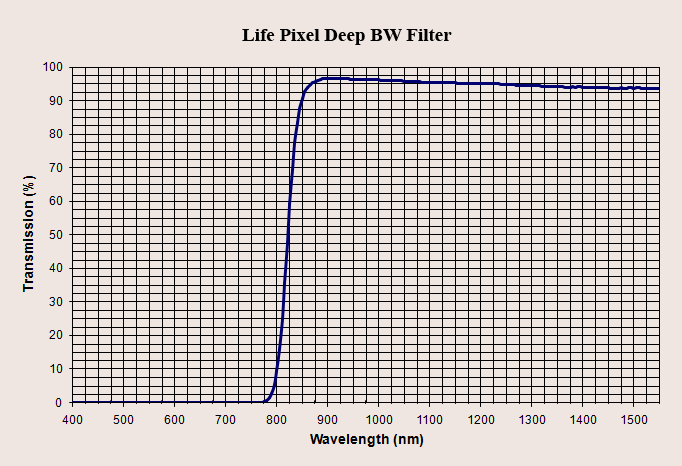
Here is our Deep BW Infrared Filter response graph:
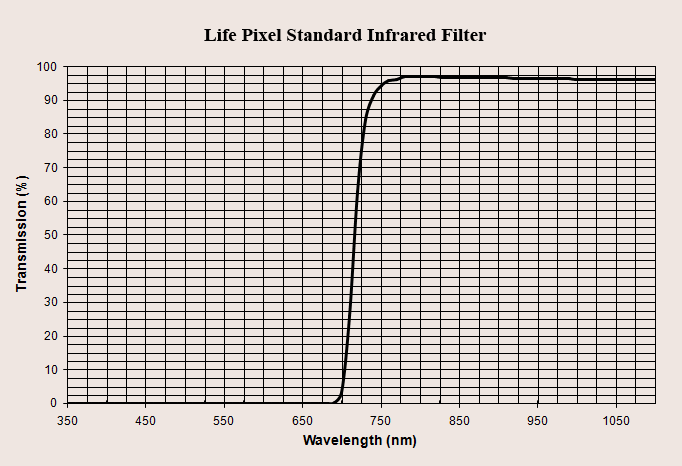
Here is our Standard Infrared Filter response graph:
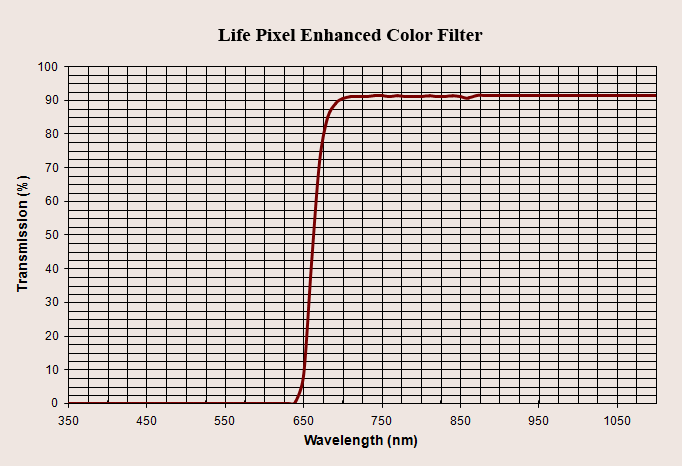
Here is our Enhanced Color Infrared Filter response graph:
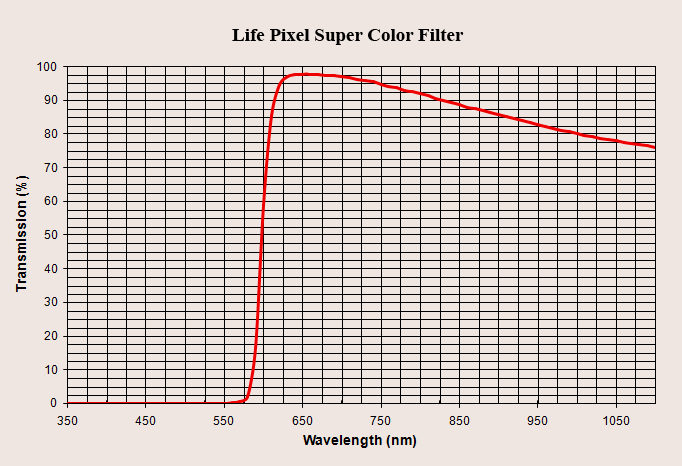
Here is our Super Color Infrared Filter response graph:
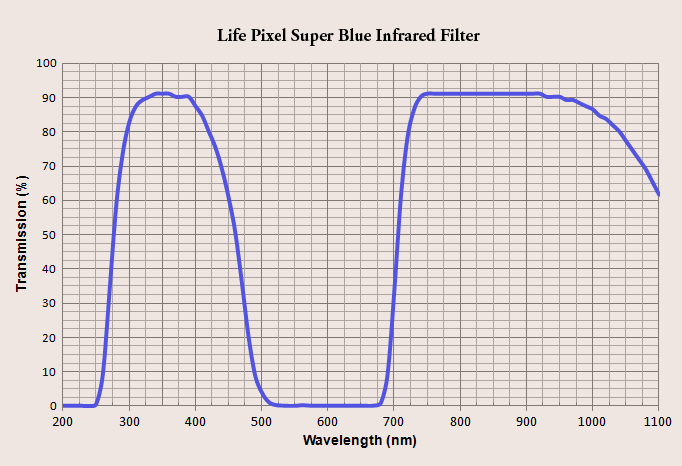
Here is our Super Blue Infrared Filter response graph:
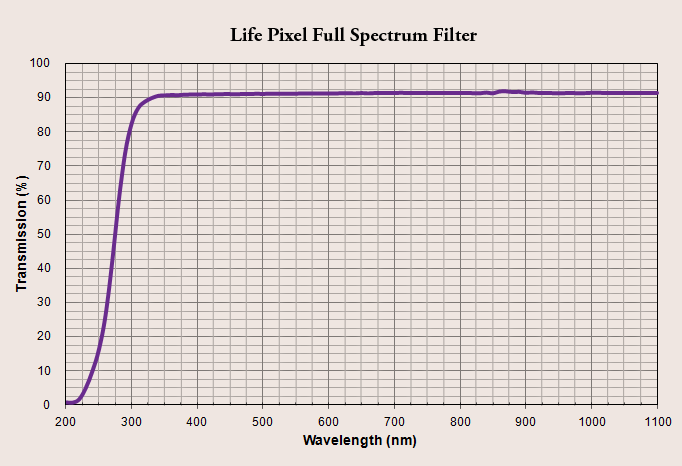
Here is our Full Spectrum Clear Filter response graph:
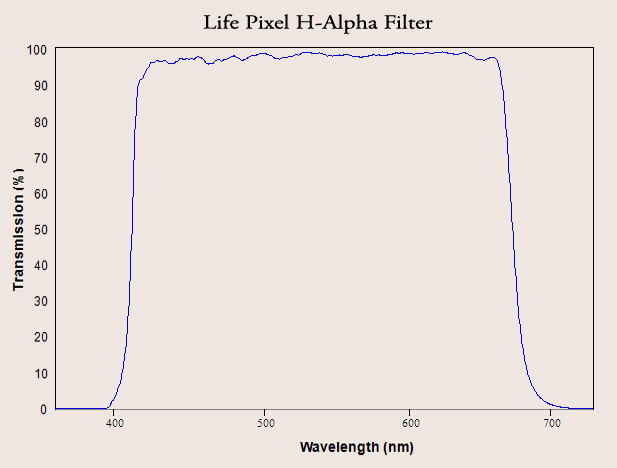
Here is our H-Alpha Filter response graph:
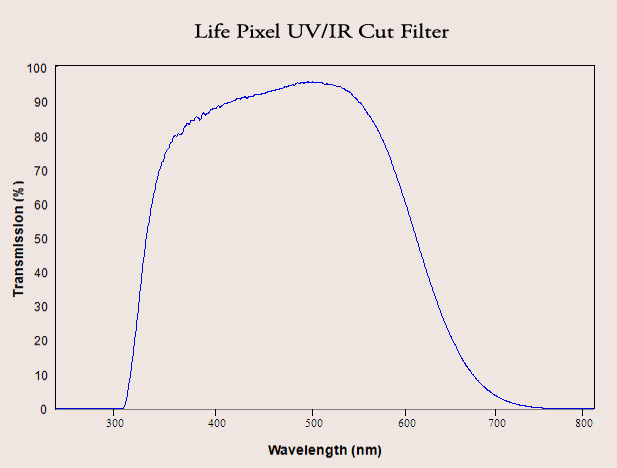
Here is our UV/IR Cut Filter response graph:
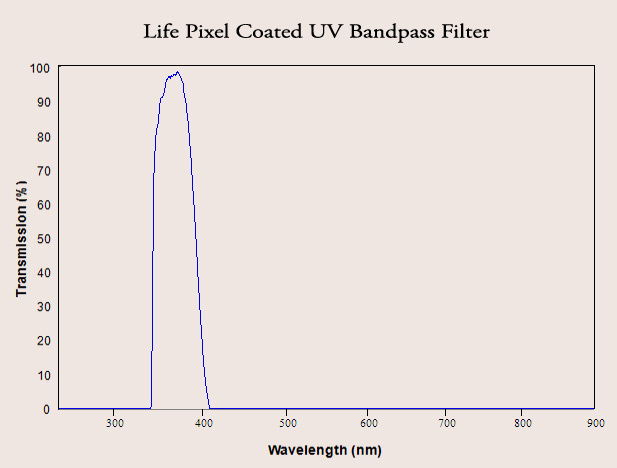
Here is our Coated UV Bandpass Filter response graph:
Can I use the camera metering after infrared conversion?
The metering will work as usual. Keep in mind that the amount of infrared light varies from scene to scene even if overall brightness is the same. Since the camera light meter senses only visible light you may need to dial in some exposure compensation, example: +1.3 stops.
Can I use the camera custom white balance function after conversion?
Most cameras will set a custom white balance just fine after conversion with the exception of some Nikon DSLRs and FujiFilm S3 Pro. With these cameras you will need to shoot RAW images and adjust the white balance to your liking in post production. Photoshop is not recommended for this, the OEM RAW conversion software like Nikon Capture NX2 and Canon Digital Photo Professional do a much, much better job, often times even better than setting the white balance in camera. Watch the below video for a detailed explanation:
[wp_lightbox_prettyPhoto_video link="http://www.youtube.com/watch?v=M-FDk_sIwvI" width="960" height="720" description="" source="https://www.lifepixel.com/wp-content/uploads/2011/06/infrared-raw-white-balance.jpg" title=""]
Do I need to manually focus to the IR mark or will the auto focus work for infrared?
We adjust the auto focus and can attain f/2.8 accuracy in most cases. For Canon DSLR cameras the lens we calibrate to is the EF 50mm f/1.8 STM lens and for Nikon and Fujifilm DSLR cameras we calibrate with the 18-70 AFS DX lens.
Each lens diffracts infrared light differently so some lenses may be a bit off in one direction or the other and with zoom lenses the focus may be different on each zoom setting and most different at the opposite ends of the range. Please refer to our focus considerations page for full details.
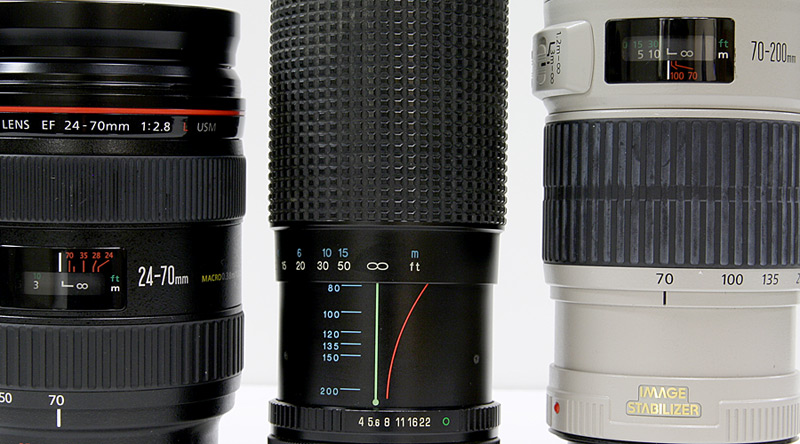
SLR lenses with various red IR focus marks
Here's a video explaining the focus shift:
[wp_lightbox_prettyPhoto_video link="http://www.youtube.com/watch?v=gqJUyEfrgOQ" width="960" height="720" description="" source="https://www.lifepixel.com/wp-content/uploads/2011/06/ir-focus-marks-on-lenses.jpg" title=""]
We also offer a custom lens calibration service were you can send in your Nikon or Canon brand or even a third party lens and we will do our best to calibrate the camera to this lens as tightly as possible. If a zoom lens is sent then we will calibrate it too the wide end of the range, unless specifically requested otherwise.
Do you make sure there is no dust trapped during the conversion?
We have a specifically designed process for dust elimination working in class 5 clean air and can get as close to a dust free conversion as is practical but in most cases there will remain a few dust specks normally invisible in photographs.
Do you provide focus adjustment instructions for DIY filter customers?
Because of the technique complexity which requires specialized custom equipment to perform, we do not provide instructions for focus adjustments. For most accurate focus please send your camera to us for conversion.
What will the noise be like after infrared conversion?
The amount of noise in infrared converted digital camera images highly depends on the subject matter, lighting and image processing. One must understand that after conversion there is only one dominant image capture channel, the red channel. The other two, blue and green capture none or very little information depending on your conversion filter type then followed by subject and lighting. These two secondary channels account for much of the noise in the image. Because as a general rule, the darker the object, the higher the noise. Add to this the fact that digital camera sensors capture RGB in the bayer pattern (think 3 color chess board, http://en.wikipedia.
Unfortunately these are the limitations with which we must work as there are no dedicated IR camera sensors being manufactured for photographic applications. Fortunately one can learn with practice how to avoid most of the issues both in image capture and post processing. The techniques are highly dependent on ones subjects and shooting/processing styles and therefore it's very difficult to give specific advice.
Is this permanent or can the camera be converted back to original?
If you decide you are no longer interested in your Life Pixel Infrared converted camera, we can reverse the conversion for most camera models. However, there are exceptions as some OEM filters are damaged in the process of removing them. Please inquire about your model if you are curious.
Can I see some example infrared images?
Sure, to see sample images on the Filter Choices and the Photo Galleries pages.
Can I see a full resolution image?
We have full resolution RAW files available for download in the filter choices section. You can also download this full resolution infrared image taken with a Canon Rebel XT converted with our standard IR filter here.
Do you provide instructions or tutorial on how to make color and black & white infrared images?
Yes, our infrared photography instructions page contains a how to video on how to do this in Photoshop.
Will point & shoot digital cameras have the same infrared image quality as DSLRs?
DSLRs usually produce better quality images over point and shoots; the noise is lower, have less JPEG artifacts and in most cases infrared images are more colorful. The Nikon Coolpix 5400 doesn't do well with color IR using our standard filter, with this model installing our Enhanced color IR filter will result in color IR images with a look somewhere between our standard and enhanced filters.
How do I clean the infrared filter in my modified digital camera?
The infrared filter can be cleaned using the same accepted methods used to clean regular digital camera sensors and are in fact more durable than the original hot mirror filters.
Do you have an affiliate program?
Absolutely! We offer excellent affiliate terms, please visit the affiliates page for further info.
If you have any further questions please feel free to contact us.
